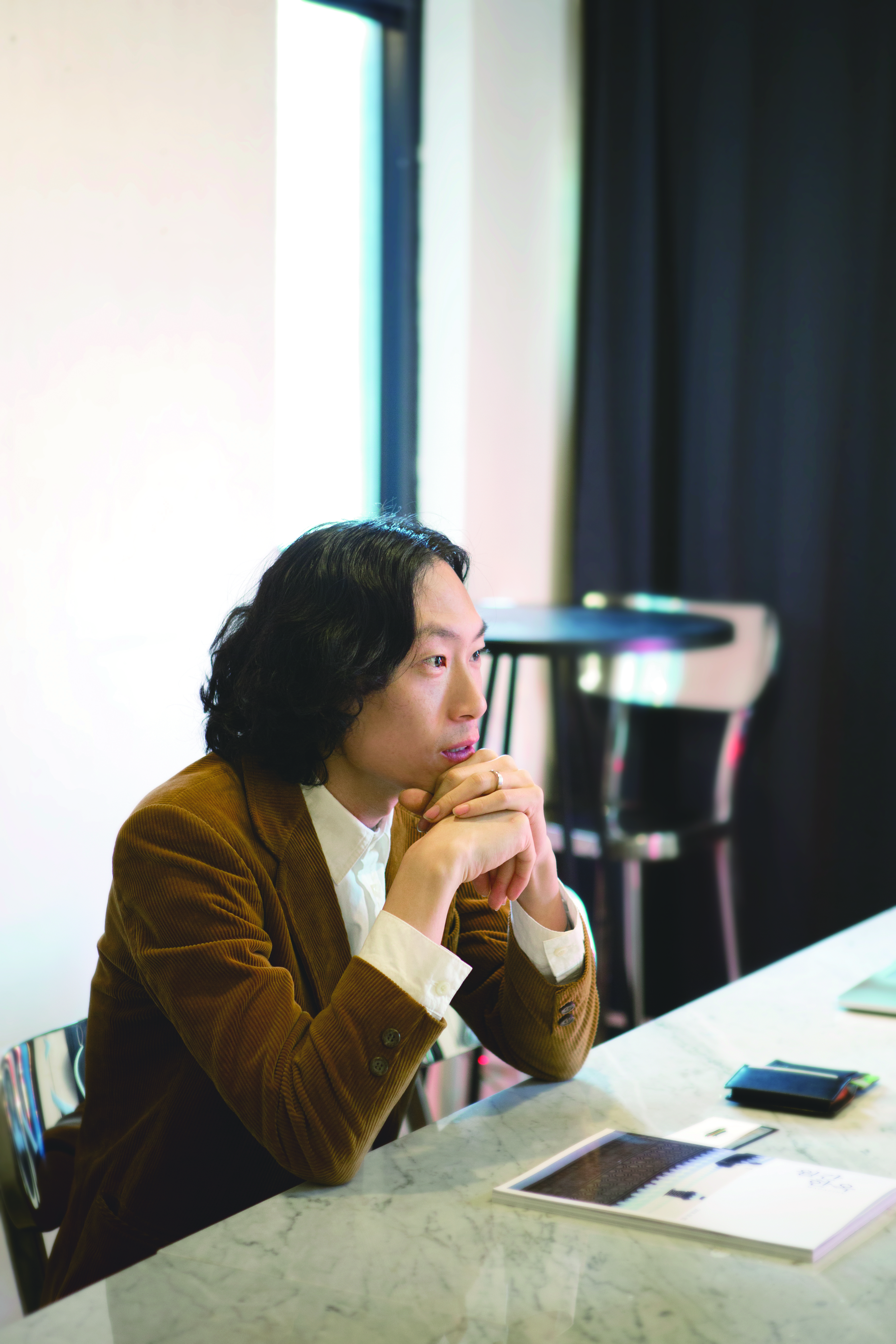
When the city lights fade and only darkness remains, Lee Seok remembers the landscape. His practice begins in that fragile moment — between disappearance and perception — where light becomes a language to re-see the world. Lee does not use technology to replicate nature. Rather, he uses it to ask a deeper question: How do we, as humans, perceive nature?
For him, the frame is not a screen but a threshold — a sensorial hinge where nature and human perception meet. “Once a frame is erected, a door opens between nature and humanity,” he says. Across his works, the frame becomes both a lens and a mirror, urging viewers to recognize their own position within the landscape they observe.
Since his first media performance at MAXXI – National Museum of 21st Century Arts, Rome (2015), Lee has continuously expanded his stage beyond museum walls — toward public architecture and heritage landscapes. His light has illuminated spaces such as the PyeongChang Olympic Memorial Hall (2021), Daereungwon Nocturne in Gyeongju (2023), and Transcendence at the Korean Cultural Center in Buenos Aires (2024, co-organized with the Cultural Heritage Administration of Korea). Through these works, his art moves steadily from image to site, from representation to experience.
The Philosophy of the Frame – A Device for Perceiving Relations
At the heart of Lee’s work lies the concept of the frame. For him, framing is not about enclosing or defining boundaries; it is about re-situating perception — making visible the relationships that connect humans, nature, and technology. In his solo exhibition “FRAME: All the Boundaries of the Earth” (2024, Artspace HoHwa), Lee pushed the frame into the realm of philosophy. Using 3D mapping projections of rock formations, tree bark, and streams he documented on-site, he reconstructed the organic rhythms of nature through data and light. Each projection became a living membrane — not an image, but a surface of exchange. The installations were deliberately placed below the viewer’s eye level.
“I wanted to unsettle our habitual downward gaze,” he explains. “By shifting the viewer’s line of sight, the act of seeing itself becomes the work.” In this way, his frame is not a boundary but a device of awareness — a reminder that every gaze carries its own position and history.
Light, Sound, and the Reordering of Sensation
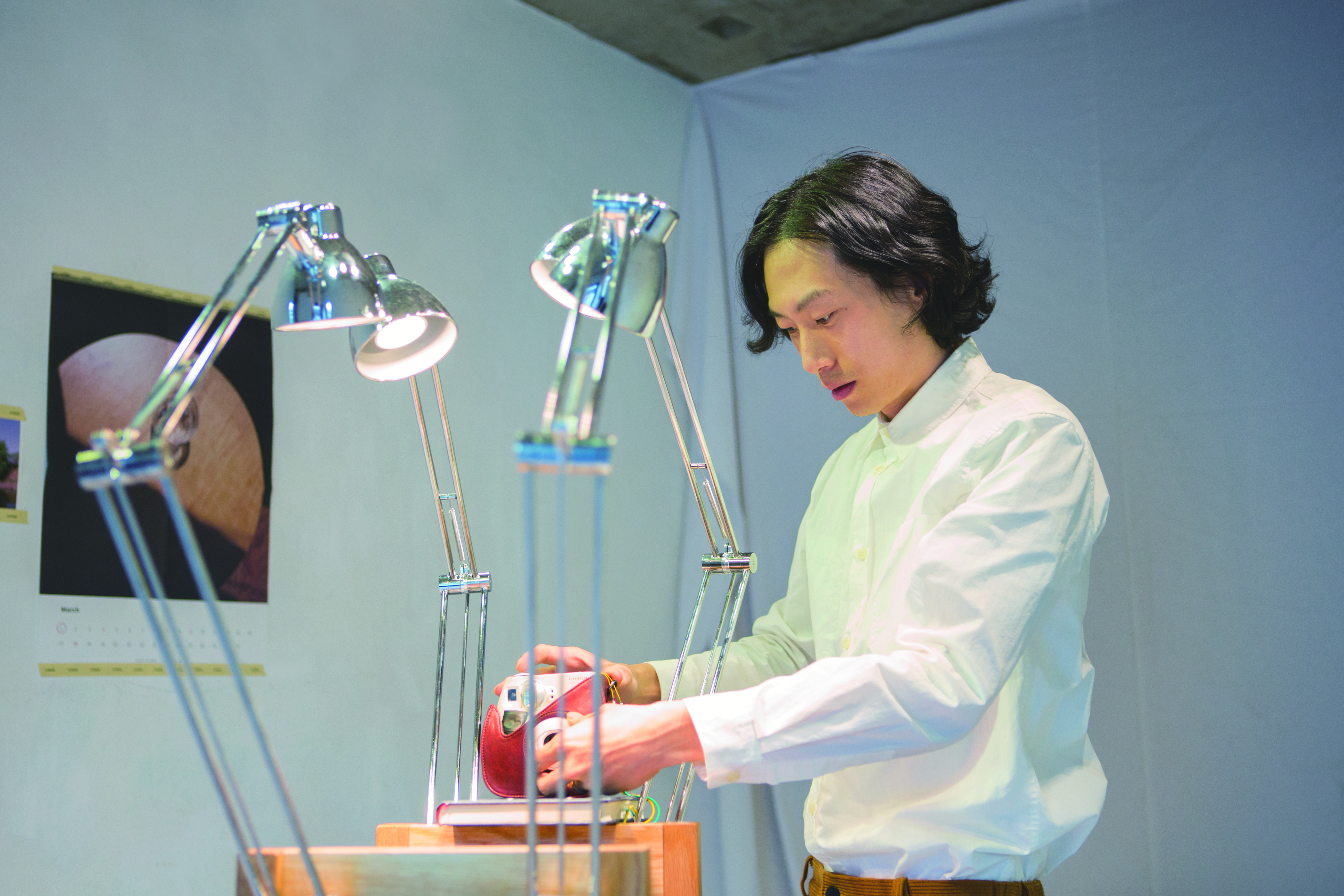
Lee’s installations are immersive compositions of light and sound. He often describes sound as “the prologue to vision.” Sound opens the spatial field; light follows. In 〈ENTER〉 (2022), low-frequency pressure, reverberation, and light expansion collided at the end of a corridor, compressing physical sensation into an experience of tension and release. 〈Into the Frame〉 visualized the unease of an era where nature is replaced by hyperconnected digital screens, while 〈Bruised Flame〉 translated the rhythm of fire — its burning and fading — into synchronized phases of light and sound.
“Sound and light move in the same phase,” he notes. “The body reacts first; the eyes follow. It’s an experiment in returning the agency of perception to the body.” In his universe, technology does not replace human senses — it reawakens them.
Illuminating Heritage – The Coexistence of Place and Time
If the frame once defined the limits of vision, Lee uses it to expand time itself. His work 〈Daereungwon Nocturne〉 (2023) exemplifies this shift. Projected onto the royal tomb complex of Gyeongju, the piece traced the contours of ancient mounds with precision and restraint, turning archaeological space into a living screen of light. Lee describes heritage not as a static relic but as a present framework of perception.
“Heritage isn’t just about preserving the past — it’s about transforming how we see in the present.” This philosophy extended into 〈Transcendence〉 (2024), a collaboration between the Korean Cultural Center in Argentina and the Cultural Heritage Administration of Korea. There, he reinterpreted Korean heritage through a global visual vocabulary, treating technology not as spectacle but as a vessel of memory. Through his light, time folds — the ancient and the contemporary coexist within a single luminous surface.
Fieldwork and the Surfaces of Nature
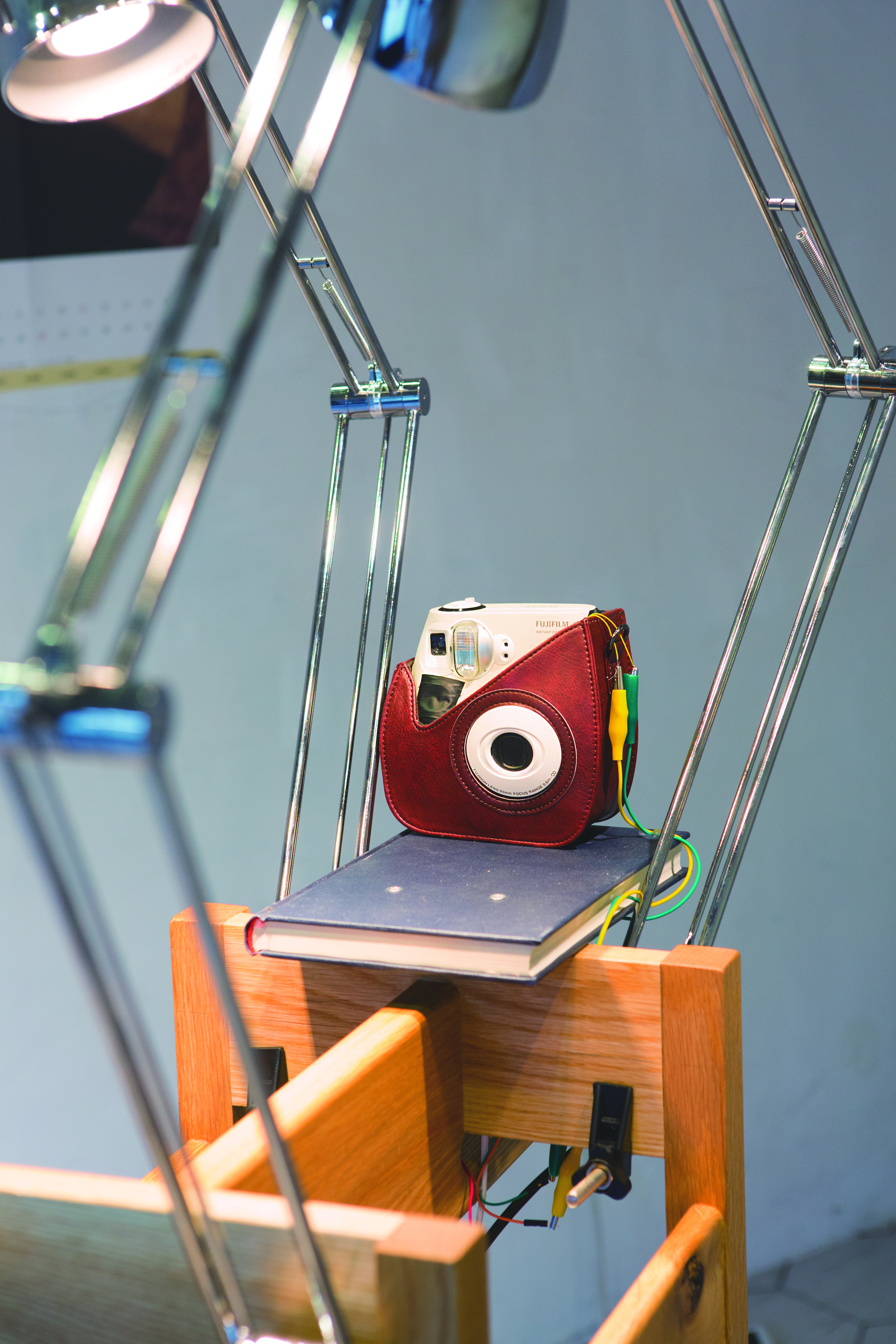
Lee’s process always begins outdoors. From the rock faces of Goheung’s coastline to the roadside trees of Seoul, he collects textures, sounds, and visual fragments, layering digital projection onto natural surfaces to reveal unseen relations.
“When artificial light overlaps with the surface of nature,” he says, “you begin to see the position from which you’re observing it.” His research transforms observation into encounter — the frame becomes not a tool of possession but a structure of relationship.
Learning, Sharing, and Expanding the Practice
Now dividing his time between Seoul and Paris, Lee continues to build a network of artists, technicians, and theorists who explore projection mapping, live visuals, and MIDI control as collaborative languages.
“The act of learning and sharing is itself part of the work,” he says. “Sharing technology is really about sharing perception.” His studio functions as an open framework, where process and exchange are as vital as the finished installation. In Lee’s view, technology is not an isolated expertise — it is a bridge between human sensitivities.
Toward the Next Frame
Lee’s upcoming project envisions an outdoor frame erected in the middle of the city — a screen where the rhythms of urban and natural time overlap. It will combine real-time sound synthesis with projection, inviting viewers to listen to the spatial pulse of the city. “The frame isn’t a closed structure,” he insists.
“It’s an open door where nature, technology, and perception meet.” Through that doorway, his art continues to evolve — from light as medium, to light as a way of thinking.
Lee Seok’s art speaks the language of technology, yet it ultimately concerns connection rather than code. His frames illuminate not just landscapes but relationships — between human and environment, light and darkness, thought and emotion.
“The frame,” he says, “is the window through which I see the world, and the mirror through which the world looks back at me.” When that window opens, the boundaries between nature and humanity, technology and feeling, begin to dissolve. That is the true work of the frame — to let the world breathe, again, through light.
More Article